FemiCore Ingredients: A Complete Breakdown of What's Inside and Why It Works
If you’ve been researching natural solutions for bladder control or recurring urinary tract infections, you’ve likely come across FemiCore. Before committing to any supplement, it’s reasonable to ask: what exactly is in it, and does the science back the claims?
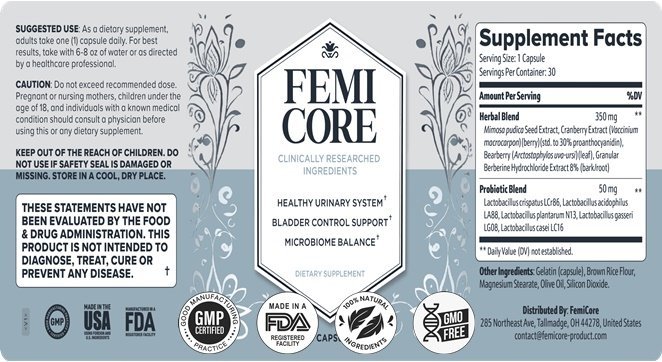
This article breaks down every active ingredient in the FemiCore formula — nine components in total, comprising five probiotic strains and four botanical cofactors — and explains the specific role each plays in urinary and vaginal microbiome health.
Why Ingredient Selection Matters for Urinary Health
Most supplements targeting bladder control either flush bacteria out temporarily or suppress symptoms chemically. Neither approach addresses the deeper issue.
Research published in the American Journal of Obstetrics and Gynecology identified a consistent pattern among women with recurring UTIs and overactive bladder: their urinary and vaginal microbiomes were significantly depleted of protective Lactobacillus bacteria. This is a structural breakdown of the body’s natural defense system — and it explains why conventional treatments provide only temporary relief.
FemiCore was formulated around this mechanism. Every ingredient targets a distinct layer of urinary and vaginal microbiome health, creating a multilayered protection framework rather than a single-point intervention.
The Five Lactobacillus Probiotic Strains
The probiotic core of FemiCore consists of five Lactobacillus species chosen for their documented activity in urinary and vaginal tissue — not the gut. Most commercial probiotics use digestive strains like L. rhamnosus or Bifidobacterium that show minimal activity in urogenital tissue. FemiCore uses a different selection entirely.
Lactobacillus Crispatus
The cornerstone ingredient. L. crispatus is the dominant organism in the vaginal flora of women with healthy bladder function. It works on two fronts: it produces lactic acid to maintain vaginal pH in the optimal 3.8 to 4.5 range, and generates hydrogen peroxide, which creates an antimicrobial environment hostile to pathogens like E. coli.
Clinical studies consistently show that women with urinary incontinence and recurring UTIs carry far lower levels of L. crispatus than women without these issues. Restoring this strain is foundational to any microbiome-based approach to bladder health.
Lactobacillus Acidophilus
L. acidophilus works through the gut-vaginal axis, creating downstream conditions in which protective strains can establish. Clinical studies show it directly reduces E. coli adhesion to urinary tract epithelial cells — relevant because E. coli is responsible for 80 to 90 percent of all UTIs. It also supports immune modulation, helping the body maintain a measured response to microbial threats rather than chronic inflammation.
Lactobacillus Plantarum
L. plantarum is one of the most acid-tolerant probiotic species available, demonstrating significantly higher survival rates through gastric transit than most comparable organisms. More viable colonies reach the intestinal tract, where urogenital colonization begins. A 2022 trial showed L. plantarum supplementation produced meaningful reductions in both the frequency and severity of recurring UTIs — making it one of the few strains with direct trial evidence in a urinary-focused population.
Lactobacillus Gasseri
L. gasseri has been studied specifically for its capacity to colonize vaginal epithelial tissue. It produces antimicrobial compounds and works in cooperation with L. crispatus to sustain the acidic environment that resists bacterial vaginosis and urinary dysbiosis — the microbiome disruptions most commonly preceding recurring UTIs. Its presence ensures the protective restoration effort reaches both urinary and vaginal tissue simultaneously.
Lactobacillus Casei
While the other strains focus on colonization and direct antimicrobial activity, L. casei contributes immune system modulation and microbiome diversity. A more diverse, immunologically supported microbiome is more resilient under stress, hormonal changes, dietary shifts, or antibiotic exposure. It functions as a long-term stabilizer — helping convert short-term colonization gains into a durable, self-sustaining protective ecosystem.
The Four Botanical Cofactors
Probiotics alone cannot complete the job. The botanical ingredients in FemiCore provide immediate urinary support while probiotic colonization establishes, directly inhibit pathogens, and reinforce the internal environment where beneficial bacteria can thrive.
Cranberry Extract (Standardized Proanthocyanidins)
Cranberry’s effectiveness depends entirely on dosage and standardization. The active protective compounds are proanthocyanidins, or PACs, which block E. coli from adhering to the urinary tract lining. Without adhesion, bacteria cannot colonize or trigger an immune response.
Most consumer cranberry products fail to deliver PACs at a clinically meaningful dose. FemiCore uses a concentrated extract standardized to the threshold shown in research to produce measurable anti-adhesion effects — which is what separates a clinically effective component from a nominal inclusion.
Bearberry (Uva Ursi)
Bearberry leaf contains arbutin, which the body converts into hydroquinone within the urinary tract. Hydroquinone is a naturally occurring antimicrobial agent that reduces bacterial load directly at the site of potential infection, without the systemic disruption associated with antibiotics. Clinical trial data supports its ability to reduce urinary discomfort and complement the anti-adhesion activity of cranberry PACs through a complementary mechanism.
Granular Berberine
Berberine is the ingredient most directly relevant to urgency and involuntary leakage. Research in the Journal of Ethnopharmacology shows berberine modulates neurogenic contractile activity in the bladder detrusor muscle — the smooth muscle whose hyperactivity produces urgency episodes and urge incontinence.
This gives berberine a unique role in the formula. While the probiotic strains and other botanicals address microbial and pH-based dimensions of bladder health, berberine works at the muscular symptom level. It also selectively inhibits pathogenic bacteria while supporting beneficial strains, reinforcing the microbiome restoration process.
Mimosa Pudica Seed Extract
Mimosa pudica addresses the gut-vaginal microbiome connection. Intestinal flora composition directly influences vaginal and urinary flora through a well-documented bidirectional axis. By supporting intestinal integrity, Mimosa pudica creates the systemic conditions in which beneficial bacteria can establish and sustain themselves throughout the urogenital system — not only at a single anatomical site.
How All Nine Ingredients Work Together
Each component of FemiCore targets a distinct layer of urinary defense:
L. crispatus and L. gasseri maintain the acidic vaginal pH that prevents pathogenic colonization. L. acidophilus reinforces this barrier through immune modulation and the gut-vaginal axis. L. plantarum ensures viable probiotic colonies survive the digestive process. L. casei builds the long-term resilience that keeps restoration stable.
Cranberry extract prevents bacterial adhesion at the urinary tract lining. Bearberry reduces bacterial viability through local antimicrobial activity. Berberine modulates bladder muscle contractions at a neurological level. Mimosa pudica reinforces the systemic gut environment that sustains the entire protective ecosystem.
The result is five layers of defense working simultaneously: pH maintenance, adhesion prevention, antimicrobial activity, bladder muscle regulation, and systemic microbiome resilience.
The Clinical Foundation
FemiCore’s formulation draws on research published in the American Journal of Obstetrics and Gynecology, Journal of Ethnopharmacology, The Lancet Microbe, and several additional peer-reviewed journals. Each ingredient was selected for documented activity in urinary or vaginal microbiome health — not for label appeal or general wellness positioning.
For women who have cycled through antibiotics, cranberry supplements, and pelvic floor exercises without lasting results, the FemiCore ingredient profile represents a structural shift in approach: targeting the ecosystem that protects the urinary tract, rather than managing the symptoms that emerge when that ecosystem fails.
Frequently Asked Questions About FemiCore Ingredients
What is the most important ingredient in FemiCore? Lactobacillus crispatus is the cornerstone strain because it is the organism most strongly correlated with healthy bladder function in clinical research. Without adequate levels of this strain, the pH-based protective environment that blocks pathogenic bacteria cannot be maintained.
Does FemiCore contain cranberry extract? Yes. FemiCore includes cranberry extract standardized for proanthocyanidins (PACs) at the dose shown in clinical research to prevent E. coli adhesion to the urinary tract lining. Most consumer cranberry products do not reach this clinical threshold.
Are FemiCore’s probiotic strains different from regular probiotics? Yes, significantly. Most probiotics are formulated for digestive health using gut-optimized strains. FemiCore uses five strains — including L. crispatus and L. gasseri — specifically studied for colonization of vaginal and urinary tissue. These organisms colonize differently, produce different protective compounds, and address the actual microbiome mechanism behind bladder and UTI issues.
How long does it take for the ingredients to produce results? The botanical components (cranberry, bearberry, berberine) begin providing urinary environment support from the first days of supplementation. The probiotic strains require more time: most women notice meaningful changes between weeks three and four, when colonization becomes sufficient to shift pH consistently. Significant improvement in overall bladder control and UTI frequency typically becomes apparent between weeks six and eight of daily use.